

De skete van de heilige Anna
DOOR
Constantijn Cavarnos
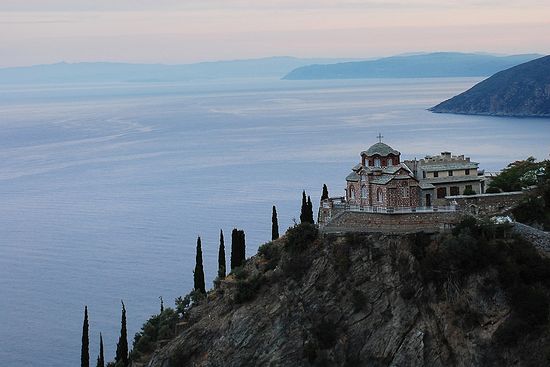
De skete van de heilige Anna
Constantijn Cavarnos
De Skete van Sint-Anna is een afhankelijke idioritmische (hermitage-stijl) skete (Klooster), een kloostergemeenschap die verbonden is aan het meer geformaliseerde Groot Lavra-klooster op de berg Athos, Griekenland.
De skete van de heilige Anna, waar wijlen bisschop Gerasimos een monnik heeft getonsureerd en vier jaar heeft gewoond, is een onderdeel van het klooster van de grootste Lavra op de heilige berg van Athos. Het is de oudste en grootste skete op de Heilige Berg, die rond het midden van de zeventiende eeuw in een gemeenschap was georganiseerd en achtenvijftig huizen omvatte. In de jaren vijftig werden deze bewoond door honderdtien monniken. Tegenwoordig worden ze door een kleiner aantal bewoond. De monniken onderhouden zichzelf door paneelpictogrammen te schilderen, geurige wierook en gebedstouwen te maken, of door ander handwerk.
Ik heb deze skete verschillende keren bezocht en heb over twee van mijn bezoeken geschreven, de ene in 1958 en de andere in 1965. Het verslag van mijn eerste pelgrimstocht staat in mijn boek Anchored in God; die van mijn tweede, in The Holy Mountain. Wat volgt bestaat uit relevante selecties uit deze boeken.
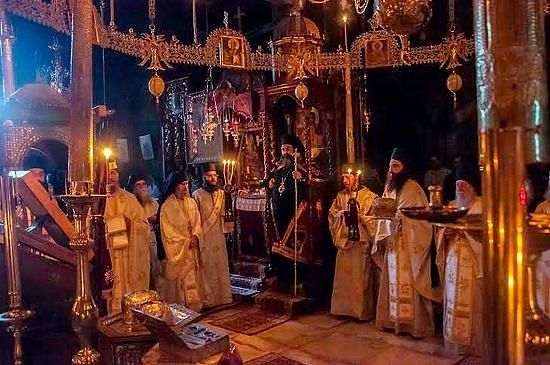
Tijdens de nacht vigilie
In Anchored in God schreef ik:
“Ik had de gelegenheid om te praten met de dikaios (prior) van de Skete, vaderPanteleimon, zijn assistent, Vader Maximos, en een aantal andere monniken, en ook om verschillende huizen te bezoeken, genaamd kalyves.
“De aanwezigheid van Maximos in het gastenverblijf, waar ongeveer een half dozijn gasten waren, verlevendigde het enorm. Maximos is jong en alert. Hij wilde de gasten op alle mogelijke manieren helpen, en aan tafel maakte zijn aanstekelijke opgewektheid en geestigheid dat iedereen met smaak kon eten.
‘S Morgens woonde ik de goddelijke liturgie bij in de kapel van het kerkhof, die vlakbij de hoofdkerk ligt. Regelmatig wordt hier op zaterdag een liturgie uitgevoerd als onderdeel van een herdenkingsdienst voor de zielen van de overledenen. Na de liturgie bezocht ik een monnik genaamd John, die mijn vriend Photios Kontoglou – de grote iconograaf – persoonlijk kende en die me had aangespoord om hem te zien. Vader John woont samen met twee andere monniken. Alle drie zijn eenvoudige, nederige, vriendelijke mannen; maar John, die ongeveer zeventig is is de oudste van het huis, en is een bijzonder sympathiek type persoon.
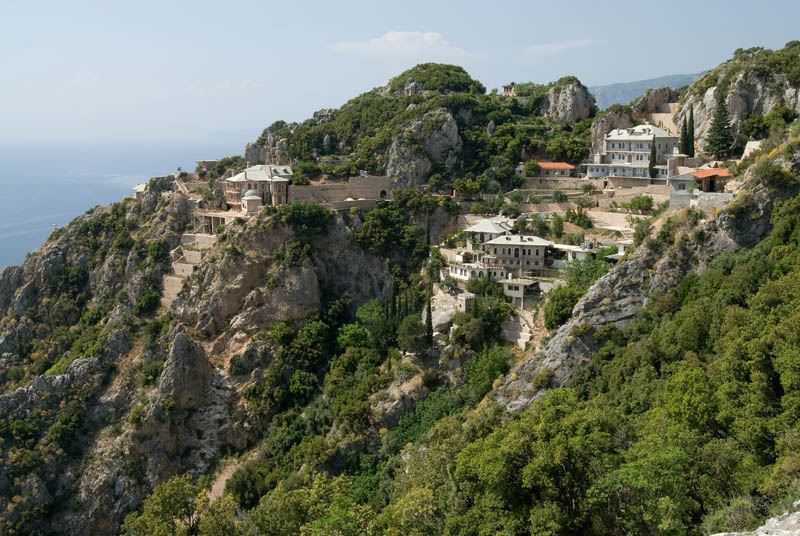
Zicht op de skete van de heilige Anna
“Het huis van deze monniken is gebouwd van puin dat is gepleisterd. Aan de kant die uitkijkt op de zee heeft het een houten veranda die uitkijkt op een terrastuin. Ik was uitgenodigd om met hen te komen eten in deze veranda. allemaal met tijd voor een dutje. Ik ging op een divan liggen in de centrale kamer van de eerste verdieping, die dienst doet als logeerkamer en woonkamer, terwijl de monniken gingen rusten in hun kamers boven. Ik zou kunnen uitleggen dat de praktijk van een dutje ook elders op Athos in acht wordt genomen, en is noodzakelijk door de lange kerkdiensten in de vroege ochtend en de frequente nachtwaken (ongeveer vijftig middagen per jaar).
‘Hoewel de buitengewoon arme John me niet wilde laten gaan zonder dat ik een paar nederige geschenken had aanvaard. Hij gaf me twee gebedskoorden, gemaakt door zijn discipelen, een voor mijzelf en een voor Kontoglou, en een Tetraevangelion in zakformaat met de vier evangeliën en de Apocalyps. Dit werk werd gepubliceerd op de berg Athos in 1933, en is een getrouwe herdruk van de uitgaven van Venetië Vader John schreef orthografisch in het Grieks de volgende opdracht:
‘Ik geef deze Tetraevangelion als een klein geschenk en souvenir aan de heer Konstantinos Kavarnos. Monnik John, iconenschilder, Kalyva van de Heilige Voorloper (Timios Prodromos), Skete van Sint Anna, Heilige Berg.
“De naam van de kalyva is afgeleid van de kapel, die is gewijd aan Johannes de Voorloper ,de Doper. Elke kalyva heeft zijn eigen kapel,
“Toen ik deze welwillende monniken verliet, ging ik naar de hoofdkerk van de skete, die is gewijd aan Sint Anna, de moeder van de Heilige Theotokos. Deze kerk is versierd met fresco’s die in 1757 werden geschilderd. Berg, die een goed vakmanschap toonde, had echt begrip van de principes van ware kunst en oprechte vroomheid. In het midden van de koepel staat Christus als Pantocrator afgebeeld. In de cirkelvormige strook direct daaronder is de ‘grote ingang’ van de liturgie afgebeeld Christus aan het dienen, en een menigte engelen. Hieronder, tussen de ramen van de koepeltrommel, zijn de profeten afgebeeld, en verderop op de pendentieven de vier evangelieschrijvers. De achtergrond van al deze schilderijen is blauw.
“Tussen de andere muurschilderingen vond ik vooral de geboorte van Christus, die is geschilderd aan de oostkant van het zuidelijke gewelf, grenzend aan de apsis van het zuidelijke koor. De kleuren en vormen zijn prachtig, de houdingen, gebaren en gezichtsuitdrukkingen vol religieus gevoel. De ingebakerde baby in de voerbak staat centraal in de compositie. Boven, in het bovenste deel van de grote donkere opening van de grot, is een ster. De hoofden van een koe en een paard, tegenover elkaar , zijn zichtbaar net achter de kribbe. Vooraan knielt Jozef links en Maria rechts van de kribbe in relatie tot de toeschouwer. Links naderen de ingang van de grot de drie Magi met geschenken, terwijl aan de rechterkant een engel en een herder zijn. In de lucht boven de grot zijn andere engelen te zien, terwijl op de voorgrond drie herders, een hond, een kudde schapen en een boom zijn afgebeeld. Een van de herders, een jongen, zit in de linker benedenhoek een pijp te spelen. Voor hem staat een hond, met zijn kop omgedraaid, naar hem kijkend. In de tegenoverliggende hoek kondigt een jonge herder de geboorte van Christus aan en maakt een gebaar naar de grot met zijn rechterhand, naar een oude herder die gebogen zit en tegen zijn wandelstok leunt. Witte schapen staan onder en achter de boom in het midden van de voorgrond.
‘De kunstenaar die dit icoon schilderde, had weinig oog voor natuurlijke verhoudingen en perspectief. Een boom is dus vrij klein en schematisch; de schapen zijn klein en onopvallend; de herders op de voorgrond zijn kleiner dan Jozef en de Theotokos, die verder weg zijn , nabij het midden van de compositie; terwijl het Christuskind groot is in vergelijking met de figuren op de voorgrond. Het is duidelijk dat de ikonenschilder opzettelijk de natuurlijke verhoudingen en het omgekeerde perspectief heeft gewijzigd om te benadrukken wat belangrijker is en om te bagatelliseren wat is minder belangrijk. ”
Op De Heilige Berg spreek ik in het bijzonder over het bijwonen van de nachtelijke wake ter ere van Sint Anna, de moeder van de Theotokos (=Moeder Gods) op 6 augustus (24 juli OS), aan de vooravond van het jaarlijkse feest. Daar zeg ik:
‘Ik ging met een motorboot naar de arsanas (landingsplaats) van de Skete van Sint Anna, aan de zuidkant van het schiereiland Athos, om naar de Skete te gaan en het feest bij te wonen ter herdenking van de Dormition of Sint Anna, aan wie deze nederzetting van kluizenaars is opgedragen. Deze skete is gebouwd op een abrupte helling op ruime afstand van de zee. Om de hoofdkerk te bereiken (bekend als de Kyriakon, omdat de monniken van de nederzetting er op zondag ( Kyriake) naartoe gingen voor collectieve aanbidding, moest ik ongeveer een half uur bergop lopen.
”De nachtelijke wake, die het hart van de viering vormde, was een van de meest memorabele ervaringen die ik heb gehad op de Heilige Berg. Het begon om 8 uur ’s avonds van het feest en ging door tot 8.30 uur in de ochtend, toen de goddelijke liturgie, die volgde op de grote vespers en metten, eindigde. Deze dienst had een spirituele grootsheid die diep ontroerde en berouw en een sterk gevoel van de aanwezigheid van God opriep. Het zingen werd gedaan door twee koren, elk bestaande uit drie monniken, allemaal met prachtige stemmen en goed opgeleid in de uitvoering van Byzantijnse muziek. Ze stonden in stalletjes langs de oostelijke muur van het schip, die in lijn is met de iconostase, en waren in westelijke richting naar de gemeente gericht. Aan het begin van de dienst was de kerk donker, verlichting wordt alleen verschaft door de kleine heilige olielampjes voor de iconen van de iconostase. Toen het rechterkoor Psalm 140 begon te zingen (Septuaginta): ‘Heer, ik heb tot U geroepen; luister naar me: luister naar de stem van mijn smeekbede … ‘een van de monniken stak de kaarsen aan van de grote kroonluchter (onder de koepel) die bekend staat als de’ corona ‘, die van de drie andere kroonluchters in het schip, en die voor de iconen van de iconostase, voor de mooie poort en elders. Zo nam de intensiteit van de verlichting geleidelijk toe totdat het hele schip goed verlicht werd. Het was een warm, pulserend licht, in tegenstelling tot het levenloze licht van elektriciteit. De heilige figuren afgebeeld op de panelen en muren werden nu zichtbaar, waardoor het gevoel van heiligheid en contact met het goddelijke werd vergroot. Dit gevoel werd nog versterkt door het veelvuldig bewieroken met de beroemde wierook uit de Athos.
“Toen de priester met luide stem zei: ‘Met vrees voor God, met geloof en met liefde naderen’, trokken veel monniken en lekengasten naar de Mooie Poort om deel te nemen aan de goddelijke gemeenschap.
” Na de liturgie, gaan allen die de diensten hadden bijgewoond, naar de refter waar eten aangeboden.’Toen de maaltijd voorbij was, hield een van de monniken van de Skete, een gepensioneerde metropoliet genaamd Anthimos, een ontroerende toespraak, waarin hij de viering in verband bracht met de doelstellingen van het kloosterleven. Het belangrijkste doel van deze gebeurtenis, zo beweerde hij, is om ons op tot God en zijn heiligen te richten, en om onze ijver op te wekken om de heiligen Anna en Joachim te imiteren, ernaar te streven hun deugden te verwerven, ons te ontdoen van ‘hartstochten’ (negatieve emoties) en slechte gedachten, om onze ziel te reinigen van al het onzuivere, zodat we geluk kunnen bereiken in het andere, eindeloze leven, en voor zover mogelijk ook in het huidige leven. “
Source: taken from the book, Agape & Diakonia: Essays in Memory of Bishop Gerasimos of Abydos, 1998
Vertaling
Kris Biesbroeck
De oorspronkelijke Engelse tekst :
Constantine Cavarnos
The Skete of Saint Anna, where the late Bishop Gerasimos was tonsured a monk and dwelt for four years, is a dependency of the Monastery of the Greatest Lavra on the Holy Mountain of Athos. It is the oldest and largest skete on the Holy Mountain, having been organized into a community around the middle of the seventeenth century and comprising fifty-eight houses. In the nineteen fifties these were inhabited by a hundred and ten monks. Today they are inhabited by a smaller number. The monks support themselves by painting panel icons, making fragrant incense and prayer ropes, or by other handicrafts.
I have visited this skete several times, and have written about two of my visits, one which took place in 1958, the other in 1965. The account of my first pilgrimage appears in my book Anchored in God; that of my second one, in The Holy Mountain. What follows consists of pertinent selections from these books. In Anchored in God I wrote:
“I had the opportunity of talking with the dikaios (prior) of the Skete, Father Panteleimon, his assistant, Father Maximos, and a number of other monks, as well as of visiting several houses, called kalyves.
“The presence of Maximos in the guesthouse, where there were about half a dozen guests, greatly enlivened it. Maximos is young and alert. He was eager to help the guests in every possible way, and at the table his contagious cheerfulness and wit made everyone eat with relish.
“In the morning, I attended the Divine Liturgy in the cemetery chapel, which is near the main church. A Liturgy is regularly performed here on Saturdays, as part of a memorial service for the souls of the departed. After the Liturgy, I visited a monk named John, whom my friend Photios Kontoglou – the great iconographer – knew personally and had urged me to see. Father John lives with two other monks. All three are simple, humble, kindly men; but John, who is about seventy and is the elder of the house, is an especially sympathetic type of person. He is an icon painter.
“The house of these monks is built of rubble that has been plastered over. On the side that faces the sea it has a wooden porch which overlooks a terraced garden. I was invited to have dinner with them on this porch. After dinner, we all retired for a nap. I lay down on a divan in the central room of the first floor, which serves as a guest room and living room, while the monks went to rest to their rooms upstairs. I might explain that the practice of an afternoon nap is observed elsewhere on Athos, too, and is necessitated by the long early morning church services and the frequent all-night vigils (about fifty a year).
“Although extremely poor John would not let me go without my accepting some humble gifts. He gave me two prayer-ropes, made by his disciples, one for myself and one for Kontoglou, and a pocket-size Tetraevangelion containing the four Gospels and the Apocalypse. This work was published on Mount Athos in 1933, and is a faithful reprint of the Venice editions. Father John wrote orthographically in Greek the following dedication:
‘I present this Tetraevangelion as a small gift and souvenir to Mr. Konstantinos Kavarnos. The Monk John, icon painter, Kalyva of the Holy Forerunner (Timios Prodromos), Skete of Saint Anna, Holy Mountain.
“The name of the kalyva is derived from its chapel, which is dedicated to Saint John the Forerunner and Baptist. Each kalyva has its own chapel, in which services are held daily.
“When I left these benevolent monks, I went to the principal church of the skete, which is dedicated to Saint Anna, mother of the Holy Theotokos. This church is decorated with frescoes that were painted in 1757. Although not among the best on the Mountain, they show good craftsmanship, real understanding of the principles of true art, and genuine piety. In the center of the dome is depicted Christ as Pantocrator. In the circular strip immediately below is represented the ‘great entrance’ of the liturgy, with Christ officiating, and a host of angels. Below this, between the windows of the dome-drum, are depicted the prophets, and further down on the pendentives, the four gospel-writers. The background in all these paintings is blue.
“Among the other wall paintings, I found the Nativity, which is painted on the east side of the south vault, adjacent to the apse of the south choir, especially interesting. The colors and forms are beautiful, the postures, gestures and facial expressions full of religious feeling. The swaddled babe in the manger is at the center of the composition. Above, at the upper part of the big dark opening of the cave, is a star. The heads of a cow and a horse, facing one another, are visible just behind the manger. In front, Joseph is kneeling to the left and Mary to the right of the manger in relation to the beholder. Approaching the entrance of the cave at the left are depicted the three Magi bearing gifts, while at the right side are an angel and a shepherd. In the sky above the cave are other angels, while in the foreground are depicted three shepherds, a dog, a flock of sheep, and a tree. One of the shepherds, a boy, is seated at the lower left hand corner, playing a pipe. In front of him is a dog, with its head turned around, looking at him. At the opposite corner, a young shepherd announces the Nativity making gesture towards the cave with his right hand, to an old shepherd who is stooped and leans against his walking stick. White sheep are under and behind the tree at the middle of the foreground.
“The artist who painted this icon had little regard for natural proportions and perspective. Thus, a tree is rather small and schematic; the sheep are little and inconspicuous; the shepherds in the foreground are smaller than Joseph and the Theotokos, who are farther away, near the center of the composition; while the Child Christ is large compared to the figures in the foreground. It is clear that the icon painter deliberately altered the natural proportions and reversed perspective, in order to emphasize what is more important and to play down what is less important.”
In The Holy Mountain I speak particularly about my attending the all-night vigil service in honor of Saint Anna, the mother of the Theotokos on August 6 (July 24 O.S.) the eve of the annual feast. There I say:
“I went by motorboat to the arsanas (landing place) of the Skete of Saint Anna, on the southern side of the Athos peninsula, in order to go up to the Skete and attend the feast in commemoration of the Dormition of Saint Anna, to whom this settlement of hermits is dedicated. This Skete is built on an abrupt slope a good distance from the sea. To reach its main church (known as the kyriakon, because the monks of the settlement gather in it on Sundays (Kyriake) for corporate worship), I had to walk uphill a for about half an hour.
”The all-night vigil service, which constituted the heart of the celebration, was one of the most memorable experiences I have had on the Holy Mountain. It began at 8 o’clock in the evening of the feast and continued until 8:30 in the morning, when the Divine Liturgy, which followed the great vespers and matins, ended. This service had a spiritual magnificence that moved one profoundly, evoking contrition and a strong feeling of the presence of God. The chanting was done by two choirs, each consisting of three monks, all of them having beautiful voices and well-trained in the execution of Byzantine music. They stood in stalls along the east wall of the nave that is in line with the iconostasis, and faced west towards the congregation. At the beginning of the service the church was dark, illumination being provided only by the small sacred oil-lamps in front of the icons of the iconostasis. When the right choir began to chant Psalm 140 (Septuagint): ‘Lord, I have cried unto Thee; hear me: attend to the voice of my supplication …’ one of the monks lit the candles of the great chandelier (under the dome) known as the ‘corona,’ those of the three other chandeliers in the nave, and those before the icons of the iconostasis, in front of the Beautiful Gate, and elsewhere. Thus the intensity of the illumination gradually increased until the whole nave became well illuminated. It was a warm, pulsating light, unlike the lifeless light provided by electricity. The sacred figures depicted on the panels and walls now became visible, increasing the feeling of holiness and contact with the divine. This feeling was further strengthened by the frequent censing with the famed Athonite frankincense.
“When the priest said in a loud intoned voice: ‘With fear of God, with faith and with love draw near,’ many of the monks and lay guests moved forward to the Beautiful Gate to partake of Divine Communion.
“After the Liturgy, food was offered in the refectory to all who had attended the services.
“When the meal was over, one of the monks of the Skete, a retired Metropolitan named Anthimos, delivered a moving speech, in which he related the celebration to the goals of monasticism. The chief purpose of this event, he asserted, is to lift us to God and His saints, and to arouse our zeal to imitate Saints Anna and Joachim, to strive to acquire their virtues, to rid ourselves of ‘passions’ (negative emotions) and evil thoughts, to cleanse our soul of everything impure, so that we might attain happiness in the other, endless life, and so far as possible in the present life als
Source: taken from the book, Agape
 christelijkeinformatiebron